
MOBILITY TACTICS
Here are the tools and techniques we use to build mobility. Ensure you have a fundamental knowledge of each so that you best execute them throughout the plan, or in additional mobility work.
Before you proceed you should read UNDERSTANDING MOBILITY
TACTIC 1 - WARMING UP
-
A warm up serves to prime the mind and body for the incoming workout. For a muscle to operate at it’s best, it needs to have warm blood flowing through it, to be taking on commands from the brain, and to be supple for action.
During this time you should also be putting aside any factors/thoughts that will distract from the workout ahead. Channel your focus and be ready for the attack.
-
This will take as long as it takes. Your aim is to get a light beading of sweat and feel mentally ready to attack the workout.
You may use a piece of equipment such as a rower or bike. You could also use your bodyweight for a light jog or a simple bodyweight movement to get warm. Note that your temperature is a big factor. We recommend warming up in layers and shedding them as you proceed through the workout.
-
Before EVERY Commando Standard Workout
TACTIC 2 - STATIC STRETCHING
-
Static stretching is an exercise where you hold a position of discomfort and familiarise yourself with that position until it becomes comfortable. It can be a good way to ‘switch off’ a muscle so that it is easier to manipulate.
Done frequently, this tactic will set previously ‘tight’ positions as the new normal - allowing you to venture further into the discomfort to find more range of motion in a joint/muscle. -
Start by knowing the muscles and joints you are looking to target. We will specify this for each exercise. If you are not feeling those targets, chances are - you are not hitting the correct shapes.
Aim to mimic the position in the exercise demonstration as best as you can. It is often ideal to work from the ground up. Note the points of contact with the floor and work up.
When you feel tightness around the target, gently progress into the stretch so that the tightness is difficult, but manageable to bear (approx 7 out of 10)
Aim to relax in the position. Keep the face relaxed and don’t pull any faces to suggest it is tough. Focus on your breathing - take a deep breath in, and gently progress further into the stretch as you exhale.
Spend 60-120 seconds working on the stretch until the tightness has reduced . -
This tactic is best done outside of your training window. Too close before training can limit your ability to be explosive in a workout. Too soon after a workout and you won’t be able to as effectively wind down and ‘switch off’ the muscles.
EXAMPLE
TACTIC 3 - DYNAMIC STRETCHING
-
This is the technique of stretching through movement. The stretch itself is only held for a short period of time, retaining the muscles elasticity, familiarising the shapes you can achieve and preparing for the task ahead. It will warm a muscle and send blood to the area - making it easier to ‘fire up’. In some cases, it can be a useful tool for practicing shapes that may feature in strength or endurance elements of the workout ahead.
You will commonly see athletes using dynamic work before competition on the sidelines or at the start line. -
You could take any static stretch and make it dynamic. You move into the stretch, hold it for a few seconds, then kill the tension before progressing into the stretch again, often prying your way deeper into the range of movement. Sometimes you may alternate between sides of the body - or move across a short distance. Each exercise can be very different. However, like with static stretching, you should have an awareness of the muscles/joints at play and how they translate the the workout ahead. This should drive the intent of the exercise.
Typically an exercise in dynamic stretching will take approx 60-120s. Over the course of that time you should build familiarity of the movements, feel warm and primed for action. -
Before a workout as the goal is to maximise the return on effort you put into the training and yield the best results. Dynamic stretching will invigorate the central nervous system and the soft tissue. Our soldiers conduct dynamic stretching to keep the body supple and un-fucked!
EXAMPLE
TACTIC 4 - SOFT TISSUE WORK
-
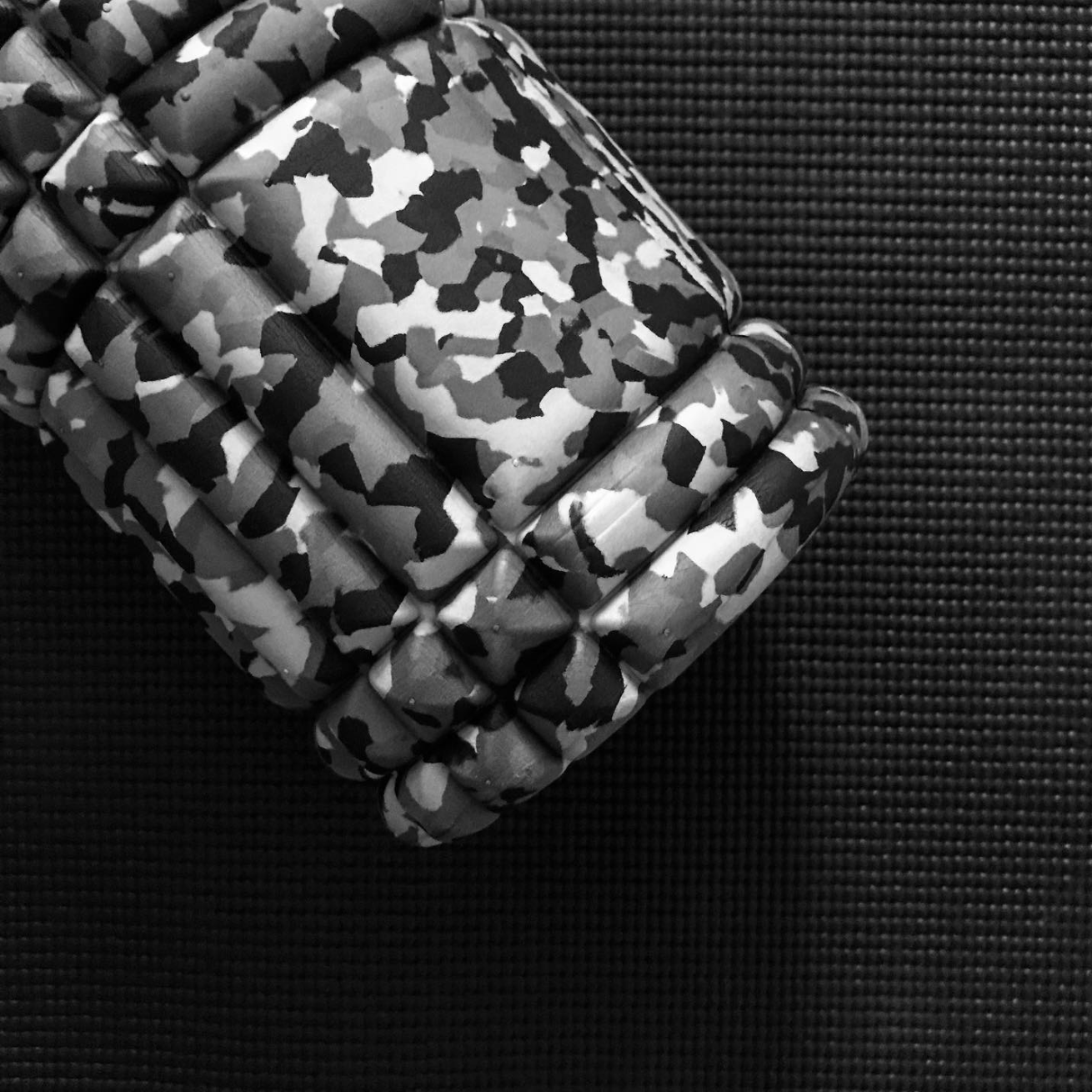
Soft tissue work using rollers or balls is there to create contact pressure on an area of tension.These areas of tension are commonly known as ‘trigger points’ or ‘knots’ - essentially they are points on the body that feel tender to the touch. They restrict movement and have the potential to refer pain elsewhere in the body.
Soft tissue work will release the knots, free up movement and allow the muscle and other tissues to work to their potential, but also in sync with one another.
-
Identify the target muscle. You will be able to identify areas of interest by the feeling tight, stiff or challenged.
Distribute your weight onto the ball/roller - move slowly and steadily until you pinpoint the target - this will be an area of particular tension. You should aim to use a tool that creates firm pressure on the target area. If the sensation is mild - that is okay. Different areas of the body may feel more challenged than others.
Aim to relax on area. If you move, do so slowly and under control. Use deep breaths to allow you to relax under the tension.
Spend a minute or so on the area until the tension reduces (it is unlikely it will vanish)
The real test is if the soft tissue work leaves you feeling better. ‘Better’ could be interpreted as lighter, less rusty or less discomfort.
Proceed across the muscle, finding any other areas of tension and repeating.
Spend 5 minutes on a target muscle.
-
Little and often. Ideally outside of a training session. It is a good way to ‘switch off’ a muscle, and therefor a good activity to do before sleep. Your aim should be to relax as this technique mimics that of a massage. After a massage, you wouldn’t want to fight - the same applies here.
EXAMPLE
TACTIC 5 - VOODOO FLOSS
-
The Voodoo band creates compression around a muscle or joint. Under this compression you can work on movements and encourage your skin, nerves, muscles and tendons to flow with one another for better interplay.
This can be useful on swollen/stiff joints and promote therapeutic benefits to a targeted area, reducing pain and inflammation.
One of the key benefits is that it allows you to work on movements that may be restricted. Under the compression of the band, you can alter the tissues at the point of restriction and free up the movement.
-
You are looking to get full coverage of the target area - setting the band a couple of inches above to a couple of inches below will create sufficient compression
It is suggested the you wrap towards the heart when dealing with swelling. However, if it is purely for mobility, this doesn’t matter.
You want to have the band at approx 50%-75% stretch (so every 10cm of band, should be stretched to approx 15-17cm).
As you wrap around, overlap the band approx half an inch.
Once wrapped. Move the target area through various ranges of motion, for 2-3 minutes.
Unwrap, let the area reload for a few minutes and repeat the process 2-3 times until you notice positive change (increase in mobility, reduction in pain/stiffness)
-
Simply put - when it feels good and provides value. It could be that before a run, your ankle is feeling restricted - a bit of flossing could provide you with the freedom for a stronger run.
Likewise it could also be utilised after the run if a joint is feeling sore or inflamed.
EXAMPLE
TEST/RETEST
The above tactics are all effective. Test/Retest allows you to put them into context. This is only applicable for those doing targeted mobility work outside of what is specified in the workouts.
With Test/Retest you can ensure all of the mobility work you do is effective and contributing to strength on and off the battlefield.
The application of Test/Retest is as follows.
We test a movement specific to our needs.
We use a mobility tactic with intent and to the best of our ability.
We retest the movement and note the improvements, or lack thereof.
If the tactic has a positive impact on the test it stays.
If it doesn’t, and has been honestly applied correctly - it goes.
Note that a positive impact could be as simple as sending blood to a target area and getting it warm. The vast majority of improvements will be subtle.
EXAMPLE
Let’s use walking up a flight of stairs for our test.
Before any mobility work - we ascend the stairs and take note of anything that doesn’t feel optimal. Perhaps an ankle feels stiff.
We utilise a mobility tactic that addresses the ankle.
We ascend the stairs again and review if it feels better.
WHY THIS WORKS
It provides intention to your mobility and equips you with the means to assess its effectiveness.
The Commando Standard suggests specific tests for the different joints. Again, this is outside of the plan and only for those that need targeted mobility work.
HOW IT FITS IN THE COURSE
Simply follow the workouts to receive a general, shotgun approach to mobility. This is our fundamental defence that must be followed by all candidates. You can use this page as a refresher on the tactics and the intentions behind them.
Some candidates will require a more specific approach. If you feel a joint needs more focus to mobilise or facilitate recovery - you can refer to the dedicated drills for targeted areas. This is done at your discretion in addition to the workouts as an optional extra.